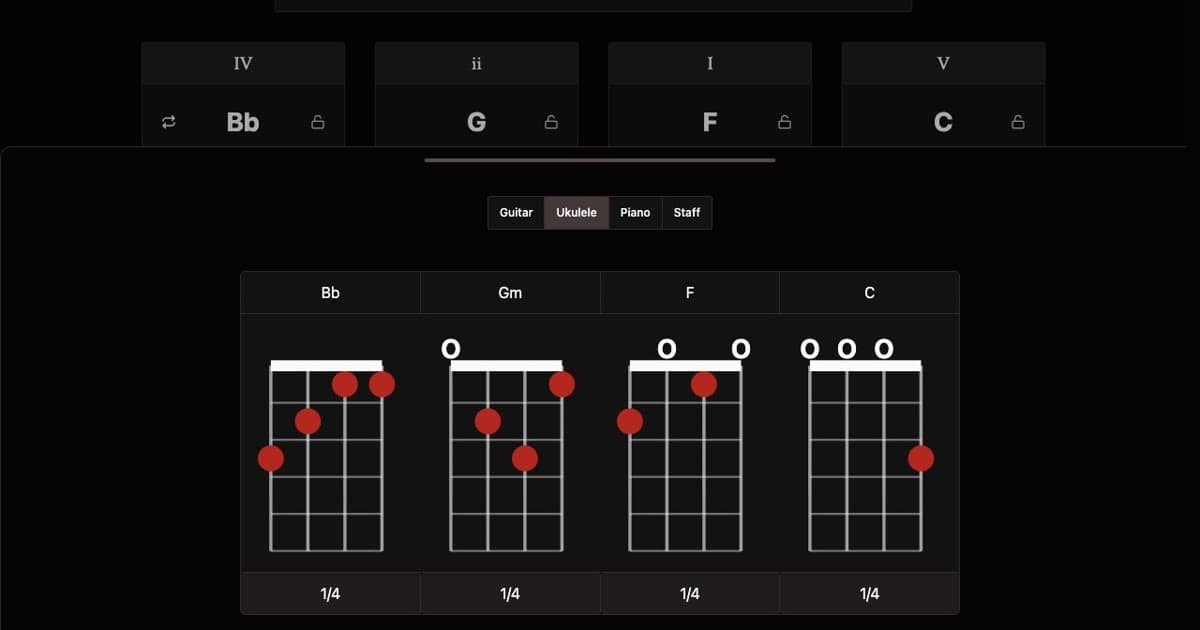
Discover chord progressions that sound great on ukulele. Generate sequences in any key, preview with built-in playback, and see the ukulele chord charts for every chord in your progression.
Each ukulele chord chart shows finger positions on all four strings. Click any chart to browse alternative shapes — ukulele chords often have multiple easy voicings thanks to the instrument's compact tuning.
Because the ukulele's re-entrant tuning puts a high G on top, chord voicings sound different from guitar even when the chord names are the same. Many common progressions fall naturally under the fingers, making ukulele a great instrument for songwriting. You can also switch to guitar tabs, piano chords, or staff notation using the tabs above.
A surprising number of keys are ukulele-friendly right out of the box. C major, G major, F major, and A minor all produce chords that sit in first position with simple one- or two-finger shapes. If you're just starting out, lock the root to one of these keys and shuffle — you'll get progressions you can play almost immediately without needing to learn barre chords.
The ukulele's compact four-string layout means most chord shapes are straightforward. Where a guitar chord might require four or five fingers stretched across six strings, the same chord on ukulele often needs just two or three fingers on four strings. This simplicity is a real advantage for songwriting — you spend less time wrestling with fingerings and more time listening to whether the progression actually sounds good.
The sequencer pairs well with the ukulele's bright, percussive tone. At moderate tempos — somewhere around 100 to 120 BPM — each sequencer step translates naturally to a chunky strum or a fingerpicked pulse. Try toggling off-beat steps to create a syncopated island-strum feel, or keep things simple with downbeats only for a steady campfire rhythm.
Enabling swing adds a laid-back shuffle that suits the ukulele like few other instruments. That slight delay on the off-beats gives the rhythm a Hawaiian or island-music quality that feels completely natural on uke. Even a straight pop progression takes on a warmer, more relaxed personality with swing turned on — it's worth toggling just to hear the difference.
Shuffle Chords
Generate new chord progressions with the shuffle button. Press this button lets you quickly cycle through chord, bpm and root configurations.
You can also use the lock controls to stop individual chords or settings from changing on shuffle.
The undo lets you revert changes and shuffles.
Chord Cards
Every chord card is divided into three interactive areas that define how a chord sounds and functions.
The top button displays the scale degree of the chord within the progression, denoted as a roman numeral. These numerals correspond the chords function within the scale. Press this button to cycle through different scale degrees.
The center of the card identifies the name of the chord. Clicking here will restart playback from this chord.
The bottom button displays and controls the quality of the chord. These can be used to shape the emotional color of the sound. Press this button to cycle through different chord qualities.
Root Selector
The root note is the tonal center of your progression and defines which notes and chords belong together.
Select any root around the circle, or use the arrows to transpose chromatically.
Detected Keys
The root note in combination with the chords determines the key of the progression. The detection algorithm analyzes your four chords and identifies the most likely key and mode. A given chord progression can belong to multiple keys and modes.
BPM Control
BPM (beats per minute) is the tempo of your progression. This determines how fast or slow it plays.
Drag the slider or click a preset to jump to a common tempo.
Sequencer
The sequencer grid controls when each sound plays within a bar. The top row triggers piano chord hits and the bottom row triggers the kick drum. Each column is one subdivision of the bar.
Click a step to toggle it on or off. The dropdown at the top left lets you swap between drum styles, and the lock icon preserves the current style when you shuffle.
Voice Leading
Voicings control where on the piano each chord is played. Neutral finds the closest voicing to the previous chord, keeping movement minimal. Up and down bias the direction, creating a sense of rising energy or descending resolution. Click a control to change the voicing for that chord.
Chord Duration
Controls how long each chord is held. 2 means each chord lasts two bars, 1 is one bar per chord, and 1/2 plays each chord for half a bar so they change quicker.
Swing
Adds a rhythmic shuffle to the beat. When swing is on, off-beat notes are delayed slightly, creating a triplet-like feel instead of a straight grid. This transforms rigid patterns into something looser and more musical.
Swing works best with styles that have off-beat hits. If no notes fall on a swing position when you toggle it on, a chord hit is automatically added so you can hear the effect immediately.