
Guitar Chord Progression Generator
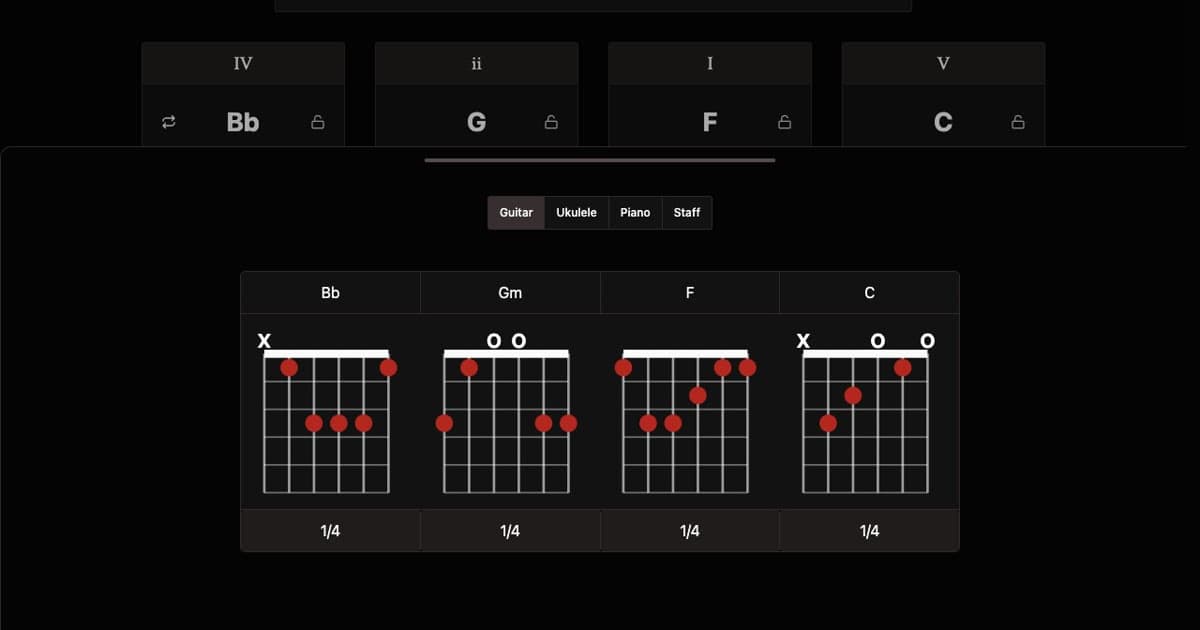
Create guitar chord progressions instantly. Whether you're jamming, writing songs, or learning music theory, generate chord sequences in any key and style. Hear how they sound with built-in playback and see the guitar chord charts for every chord in your progression.
Chord Charts
Each chord chart shows you exactly where to place your fingers on the fretboard. Dots mark fret positions, an X means the string is muted, and an O means it rings open. Click any chart to browse alternative guitar tabs and find shapes that suit your hand or playing style.
You'll see a mix of open chords and barre chords depending on the key. If a shape feels awkward, tap through the alternatives — there's usually a simpler voicing further up the neck. You can also switch to piano chords or staff notation using the tabs above.
Best Keys for Guitar
Shuffling through progressions is one of the fastest ways to stumble onto something that feels right on guitar. Keys like G, C, D, E, and A major are especially worth exploring because they produce chords built around open shapes — the kind that ring out with the sustain and resonance that make acoustic guitar sound so full. If you lock the root to one of these keys, every shuffle will stay in guitar-friendly territory.
Strumming & Sequencer
The sequencer grid maps naturally to strumming. Think of each active step as a strum — toggle steps on and off to build a rhythmic pattern, then let playback loop while you practice along. Leaving a step silent creates a rest, which gives your strumming hand space to mute or add a percussive scratch.
Voice Leading on Guitar
Voice leading on guitar means finding chord shapes that share fret positions or move as little as possible between changes. When the voicing control is set to neutral, the generator picks inversions with minimal movement — the same principle guitarists use when they choose a C/E shape to transition smoothly into an Am. Less finger travel means cleaner changes and a more connected sound.
Tempo Guide
Tempo makes a big difference in how a guitar progression feels. Acoustic ballads and fingerpicking tend to sit around 70 to 90 BPM, giving each chord room to breathe. Pop and singer-songwriter strumming usually lands between 100 and 130 BPM. If you're writing something with punk or rock energy, push the tempo past 140 and notice how the same chords take on a completely different character.