Loading
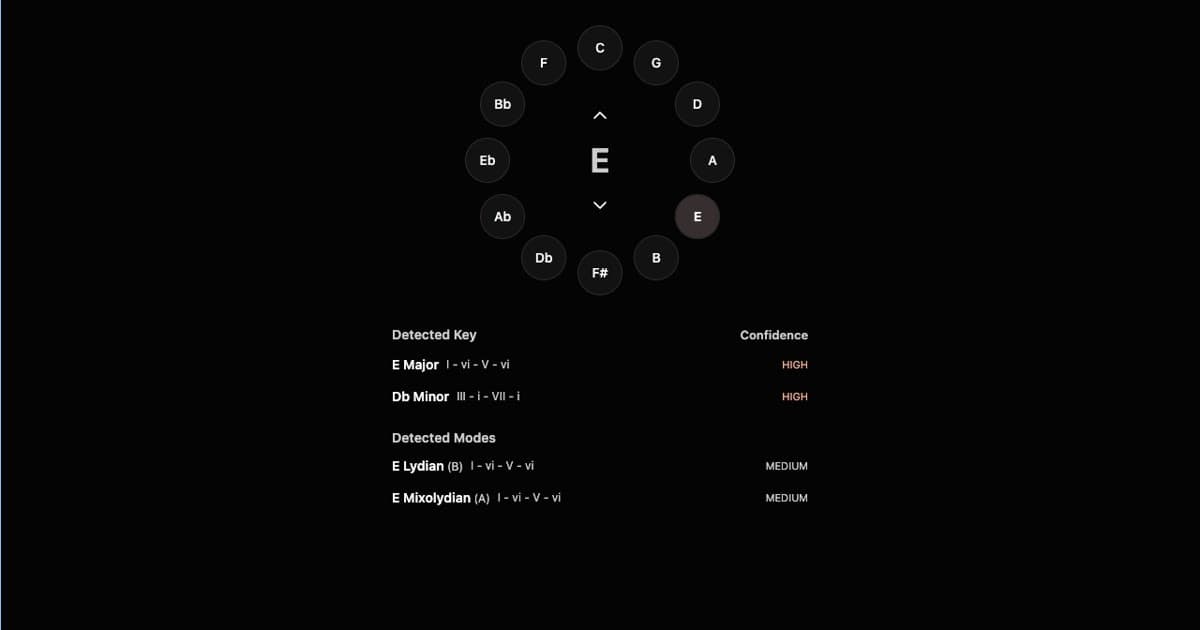
The key of E Major contains seven diatonic chords: E, F#m, G#m, A, B, C#m, D#m. Use the interactive generator below to build progressions, hear them played back with drums and accompaniment, and export to MIDI.
The relative minor of E Major is C♯ Minor. Both keys share the same set of notes and diatonic chords, but centre on a different tonic — making C♯ Minor the natural choice for a darker or more melancholic feel.
Every mode below is built from the same seven notes as E Major, starting on a different scale degree.
E Major is one of the most guitar-friendly keys in existence. The open E chord uses all six strings, producing a full, resonant sound that has made it a staple of rock, blues, and country music.
Classic blues progressions (E–A–B7) and rock power-chord riffs both exploit E Major's natural resonance on guitar. Artists from Chuck Berry to The Beatles to Jimi Hendrix have built iconic songs around this key.
With four sharps, E Major is slightly more involved on piano but still straightforward. Its bright, cutting quality also makes it a popular key for pop anthems and stadium-rock sing-alongs.
The 12-bar blues I–IV–V (E–A–B7) is the foundation of rock and roll in this key. The I–V–vi–IV (E–B–C♯m–A) appears in songs like "Teenage Dirtbag" by Wheatus. For a darker flavour, the I–♭VII–IV (E–D–A) mixolydian-borrowed progression drives classic rock tracks like "Sympathy for the Devil" by The Rolling Stones.
On guitar, the open E (022100), A (x02220), and B7 (x21202) shapes require no barre chords and take full advantage of the instrument’s open strings. Power chords rooted on the low E string are at their most resonant here. On piano, the four sharps (F♯, G♯, C♯, D♯) create a hand position where the thumb crosses naturally, making scale passages smooth once the fingering is memorised.
E Major’s relative minor is C♯ minor, heard in songs like "Somebody That I Used to Know" by Gotye. The dominant key (V) is B Major and the subdominant (IV) is A Major. The E–A–B triangle is one of the strongest key relationships in guitar music, and songs frequently borrow between all three.