Loading
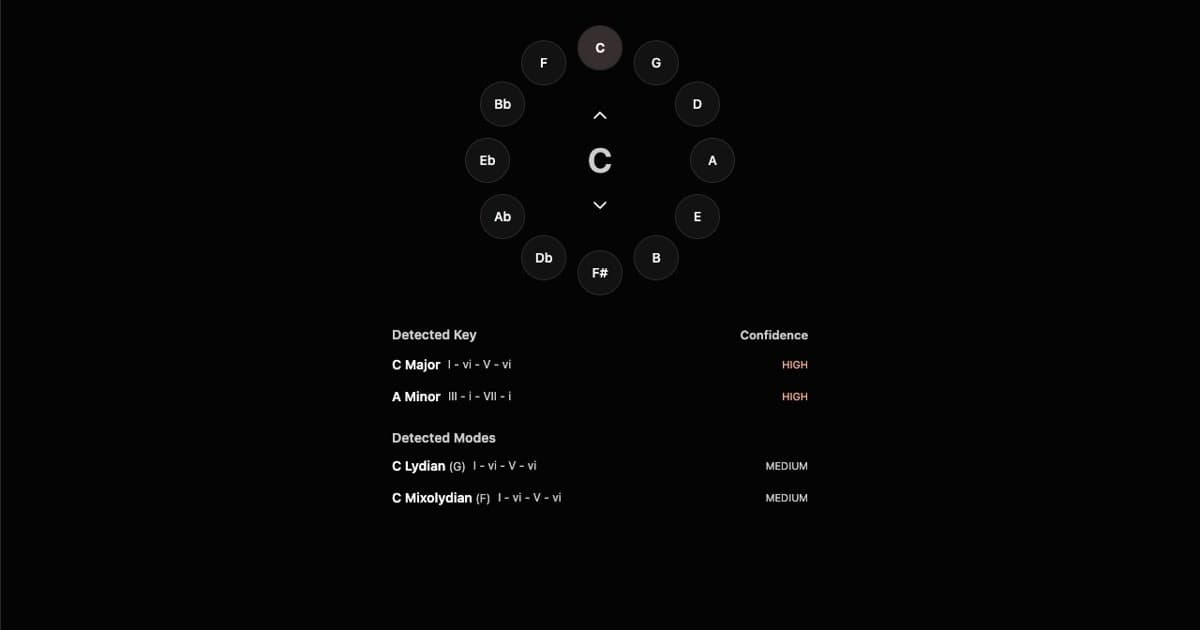
The key of C Major contains seven diatonic chords: C, Dm, Em, F, G, Am, Bm. Use the interactive generator below to build progressions, hear them played back with drums and accompaniment, and export to MIDI.
The relative minor of C Major is A Minor. Both keys share the same set of notes and diatonic chords, but centre on a different tonic — making A Minor the natural choice for a darker or more melancholic feel.
Every mode below is built from the same seven notes as C Major, starting on a different scale degree.
C Major is the most common key in Western music. With no sharps or flats, it maps directly to the white keys on a piano, making it the natural starting point for beginners on any instrument.
The I–V–vi–IV progression (C–G–Am–F) is one of the most widely used chord patterns in pop music, appearing in countless hits across decades. C Major's simplicity makes it an ideal key for learning music theory fundamentals like intervals, triads, and voice leading.
Despite its reputation as a beginner key, C Major is used extensively in professional recordings. Its neutral character means it works across virtually every genre, from classical sonatas to electronic dance music.
The I–V–vi–IV (C–G–Am–F) appears in songs like "Let It Be" by The Beatles and "No Woman, No Cry" by Bob Marley. The I–vi–IV–V (C–Am–F–G) drives "Every Breath You Take" by The Police. For something more melancholy, the vi–IV–I–V (Am–F–C–G) underpins "Someone Like You" by Adele.
On piano, C Major requires no black keys for diatonic chords, making it perfect for working out voicings and inversions. On guitar, the open C, G, Am, F, and Dm shapes are all accessible early on, though the F barre chord can trip up newer players — try the Fmaj7 (xx3210) as an easier substitute.
C Major’s relative minor is A minor, which shares all the same notes and is the most common minor key in popular music. The dominant key (V) is G Major and the subdominant (IV) is F Major — both easy keys that make modulating from C feel seamless and natural.