Loading
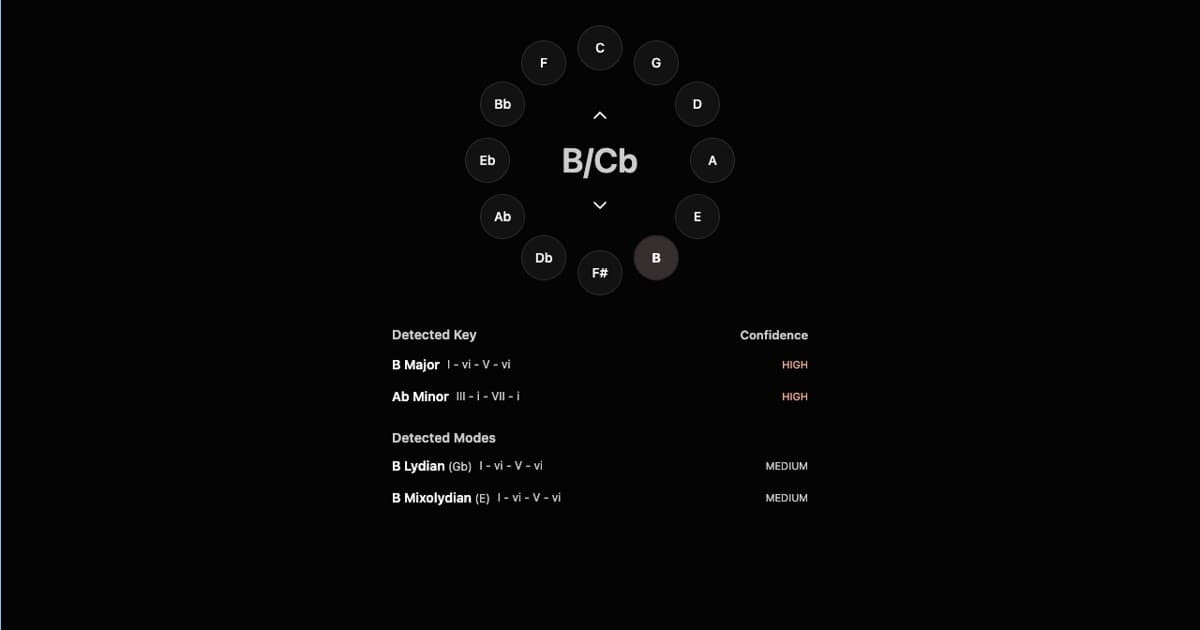
The key of B Major contains seven diatonic chords: B, C#m, D#m, E, F#, G#m, A#m. Use the interactive generator below to build progressions, hear them played back with drums and accompaniment, and export to MIDI.
The relative minor of B Major is G♯ Minor. Both keys share the same set of notes and diatonic chords, but centre on a different tonic — making G♯ Minor the natural choice for a darker or more melancholic feel.
Every mode below is built from the same seven notes as B Major, starting on a different scale degree.
B Major's five sharps give it a bright, piercing quality that can feel intense and energetic. While less common than guitar-friendly keys like G or D, B Major is used effectively in pop, rock, and electronic music.
On guitar, most B Major chords require barre shapes, which makes it more demanding to play but also produces a tighter, more controlled sound. Many guitarists use a capo to simplify B Major voicings.
In classical music, B Major is associated with brilliant, crystalline textures — Chopin wrote several notable works in this key. In modern production, the key's distinctiveness makes it a strong choice when a song needs to stand apart from the pack.
The I–V–vi–IV (B–F♯–G♯m–E) is the standard pop progression in this key, heard in "Don't Stop Believin'" by Journey (which uses E Major but modulates through B). The I–IV–V (B–E–F♯) provides a straightforward rock framework. For a more sophisticated sound, the I–vi–ii–V (B–G♯m–C♯m–F♯) adds jazz-influenced movement.
On guitar, a capo at the 2nd fret with open A shapes (A, D, E become B, E, F♯) is the easiest approach. Alternatively, a capo at the 4th fret with open G shapes works well for folk-style strumming. Without a capo, the B barre chord (x24442) and F♯ (244322) are both rooted on the 5th and 6th strings respectively. On piano, the five sharps require familiarity with black keys, but the hand position is symmetrical and comfortable once learned.
B Major’s relative minor is G♯ minor, an intense key used in classical works by Chopin and in modern electronic music. The dominant key (V) is F♯ Major (enharmonically G♭ Major) and the subdominant (IV) is E Major. Moving from B to E is one of the most natural modulations in guitar music, given that E Major is such a resonant open key.